


News Topics
Trump says Iran war "close to over" as Pakistan pushes for new peace talks
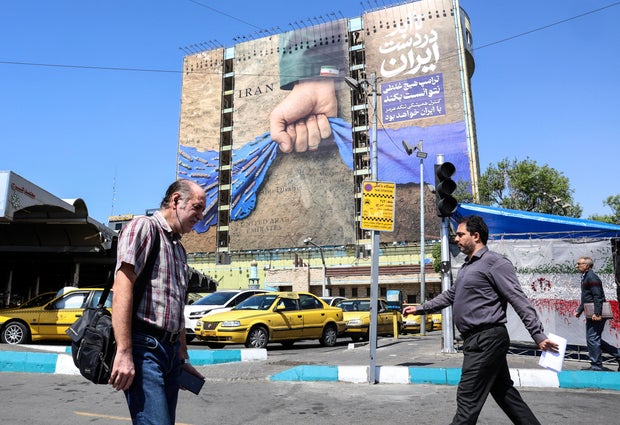
Iranians walk past a large billboard referencing the Strait of Hormuz in Tehran's Vanak Square, April 15, 2026. AFP via Getty
What to know about the Iran war today:
o President Trump is again voicing optimism about a potential deal with Iran to end the war currently paused by a two-week ceasefire. Mr. Trump told Fox News the conflict is "very close to over" as he and Pakistan's leader suggest a new round of direct U.S.-Iran peace talks could be looming.
o The regime in Tehran is challenging the U.S. military's claim to have "completely halted economic trade going into and out of Iran by sea," and ship tracking data show some vessels, including sanctioned tankers, are still transiting the Strait of Hormuz, as both countries try to show they're in control of the strategic shipping lane.
o The Iran war continues to drive a deeper wedge between the U.S. and its NATO allies and between President Trump and the leader of the Catholic Church. Mr. Trump has lashed out again at Pope Leo for calling for an end to the war, and for what he considers NATO's failure to support the U.S.-Israeli attacks on Iran.
Iran says no date set yet for new round of direct talks with U.S.
Iranian Foreign Ministry spokesman Esmail Baqaei said Wednesday that no date had been set for a new round of direct negotiations between Iran and the U.S.
President Trump has voiced hope that a second round of direct talks could begin in the coming days, which he predicted would be "amazing," and Pakistani officials say they are working to facilitate such negotiations again.
Senior officials from Pakistan, which has acted as an intermediary between Washington and Tehran, were expected in Tehran on Wednesday as part of efforts by Islamabad to keep the diplomacy going.
Trump says China "agreed not to send weapons to Iran"
President Trump said Wednesday that China has agreed not to provide weapons to Iran, as reports circulate that Beijing has considered transferring arms.
"China is very happy that I am permanently opening the Strait of Hormuz," Mr. Trump said in a post on Truth Social. "I am doing it for them, also — And the World. This situation will never happen again. They have agreed not to send weapons to Iran. President Xi will give me a big, fat, hug when I get there in a few weeks. We are working together smartly, and very well!"
Mr. Trump said in an interview Tuesday with Fox News host Maria Bartiromo that he wrote a letter to China's President Xi Jinping asking him not to give Iran weapons. "And he wrote me a letter saying that essentially, he's not doing that," Mr. Trump said.
China has long supported Iran's ballistic missile program and backed it with dual-use industrial components that can be used for missile production, according to the U.S. government.
U.S. and Iran acknowledge ongoing, indirect dialogue, but U.S. officials say no new agreements yet
U.S. officials told CBS News on Wednesday that talks on extending the current two-week ceasefire with Iran, which is set to expire on Tuesday, were ongoing, but that there has been no agreement yet on terms.
"The United States has not formally agreed to an extension of the ceasefire," a senior U.S. official said Wednesday. "There is continued engagement between the U.S. and Iran to reach a deal."
Iran's Foreign Ministry acknowledged Wednesday that the regime was engaged in indirect communications with the U.S., meanwhile, but said the aim is a complete end to the war and a lifting of sanctions against Tehran.
President Trump has said he's optimistic that a new round of direct talks could soon bring a final agreement to end the war.
"Regarding talks and negotiations, the exchange of messages is continuing," Foreign Ministry spokesman Esmail Baqaei said Wednesday in remarks aired by Iranian state TV. "Since Sunday, when the Iranian delegation returned to Tehran, multiple messages have been exchanged through a Pakistani intermediary."
Baqaei said Iran's "positions are very clear" and that the ongoing diplomacy, in Tehran's view, is "aimed at a complete cessation of war and the restoration of Iran's rights, including not only the lifting of sanctions but also compensation for damages inflicted on Iran during the imposed war by the United States and the Israeli regime."
Baqaei said Iran was "likely hosting a Pakistani delegation" on Wednesday "in continuation of the discussions that took place in Islamabad and the talks the Pakistani side has had with the United States; our positions have been heard and conveyed."
Iran again threatens Red Sea shipping after previous warnings over Bab el-Mandeb Strait
The head of Iran's central military command said Wednesday that if the U.S. continues with its blockade of Iranian ports in the Persian Gulf and "creates insecurity for Iran's commercial vessels and oil tankers," the country will extend its own efforts to disrupt shipping to another key waterway in the Middle East.
"The powerful armed forces of the Islamic republic will not allow any exports or imports to continue in the Persian Gulf, the Sea of Oman, and the Red Sea," Ali Abdollahi said in a message conveyed by Iranian state media.
Iran has threatened on at least two previous occasions during the war to block shipping from the Red Sea, where a number of ports vital to global energy markets sit on the coastlines of Saudi Arabia and other nations. The southern gateway to the Red Sea is the narrow Bab el-Mandeb Strait, an effective chokepoint that could be subjected to attacks by the Iranian-backed Houthi rebels in Yemen.
The Houthis control a vast portion of Yemen bordering the Red Sea, where they have attacked ships before. Like the Strait of Hormuz, over which both the U.S. and Iran claim to have control, the Bab el-Mandeb is a vital conduit for natural gas and oil products exported from the Middle East.
An estimated 10% of the world's oil supply flows through the passage, which is bordered by Djibouti to the south and Yemen to the north.
An Iranian military official was first quoted in late March by the country's state media as saying the Bab el-Mandeb could be targeted.
While the Houthis have stayed out of the Iran war thus far, its leaders have warned they could wade into the conflict if Tehran asks them to.
Sanctioned ships appear to enter Persian Gulf through Strait of Hormuz as U.S. claim full blockade
U.S.-sanctioned ships appeared to be entering the Persian Gulf through the Strait of Hormuz on Wednesday, hours after a top U.S. military commander said a blockade of Iranian ports was "fully implemented."
Ship tracking data show a number of vessels, including the crude oil tanker Alicia — making the journey overnight. The Chinese-owned Alicia has previously called at Iranian ports.
The Alicia appeared to alter its course in the Gulf of Oman when the blockade began, but then continued through the Strait of Hormuz overnight, along with at least two other oil tankers.
Two Iran-flagged container ships, both subject to U.S. sanctions, also appeared to leave the Persian Gulf Tuesday and were continuing to sail close to Iran's south coast Wednesday.
A CBS News analysis of ship tracking data from earlier this week appeared to show a number of other Iran-linked ships passing through the Strait of Hormuz in the hours after the U.S. blockade of the waterway began on Monday.
The U.S. military said its blockade would apply to "all maritime traffic entering and exiting Iranian ports," but that it would "not impede freedom of navigation for vessels transiting the Strait of Hormuz to and from non-Iranian ports."
Iran's state media claimed Wednesday morning that a bulk carrier transporting food supplies — and an Iranian crude oil tanker — had entered Iranian waters after transiting the Strait of Hormuz, despite the U.S. blockade.
Iran's Fars News Agency said a supertanker capable of transporting 2 million barrels of oil had sailed through international waters and the Strait of Hormuz with its tracking system switched on, "without any concealment.
Despite tension with U.K. over war, Trump says he's looking forward to King Charles' visit
President Trump called Britain's King Charles "a fantastic person" ahead of his state visit to the U.S. later this month.
In an interview with U.K. broadcaster Sky News, Mr. Trump said he was looking forward to "all of" Charles' visit.
"Just being with him. I've known him for a long time. He's wonderful. Wonderful person," Mr. Trump said.
But the president reiterated his dissatisfaction with Prime Minister Keir Starmer, criticizing the British leader's decision not to join the U.S.-Israeli strikes on Iran.
When asked about the so-called "special relationship" between the U.S. and U.K., Mr. Trump said "when we asked them [the U.K.] for help [with the Iran war], they were not there. When we needed them, they were not there. When we didn't need them, they were not there. And they still aren't there."
Mr. Trump appeared to threaten a trade deal previously negotiated between the U.S. and the U.K.
"We gave them a good trade deal. Better than I had to. Which can always be changed," he said.
The president also renewed his criticism over the Starmer government's policies on energy and immigration.
U.K. finance chief "frustrated and angry" over Iran war's economic impact on Britain
U.K. Chancellor of the Exchequer Rachel Reeves is set to meet with her American counterpart, Treasury Secretary Scott Bessent, in Washington on Wednesday after voicing frustration over the economic fallout from the U.S.-Israeli war with Iran.
The International Monetary Fund has warned that the energy price shock due to the war will hit the U.K. harder than any other advanced economy, though the IMF expects Britain to rebound next year and show rapid economic growth compared to its G7 peers.
Before she departed for the U.S., Reeves told the British tabloid the Daily Mirror that she was "very frustrated and angry" about how the war will impact Britain's economy.
"This is a war that we did not start. It was a war that we did not want," Reeves said. "I feel very frustrated and angry that the U.S. went into this war without a clear exit plan, without a clear idea of what they were trying to achieve. And as a result, the Strait of Hormuz is now blocked."
Reeves said she was frustrated by "the impact it's having on families and businesses in our country."
"Obviously, no sensible person is a supporter of the Iranian regime, but to start a conflict without being clear what the objectives are and not being clear about how you are going to get out of it, I do think that is a folly and it is one that is affecting families here in the U.K., but also families in the U.S. and around the world," Reeves said. "I don't think it was the right decision. But it was absolutely the right decision for Keir Starmer - our prime minister - to keep us out of this conflict."
Israeli army strikes south of Beirut as Hezbollah launches more rockets at Israel
Two Israeli strikes hit vehicles south of Beirut on Wednesday, state media reported, while Hezbollah launched rockets at Israel, hours after Lebanon and Israel held historic direct negotiations.
Israel is continuing its strikes on southern Lebanon in its war with Iran-backed Hezbollah but had not targeted the Lebanese capital since a series of attacks across the country on April 8 that killed more than 350 people.
Lebanon's state-run National News Agency reported two separate Israeli strikes on two vehicles, one in the seafront town of Saadiyat and another on a coastal highway in neighboring Jiyeh, around 12 miles south of Beirut and outside Hezbollah's traditional strongholds.
NNA also reported several other strikes across southern Lebanon.
The Israeli military said it had detected "approximately 30 launches" by Hezbollah militants toward Israel since the early hours of Wednesday, a spokesman told AFP.
Hezbollah said it launched rockets at 10 northern Israeli areas.
The attacks come a day after Lebanon and Israel's ambassadors to the United States held their first direct talks in decades in Washington and agreed to hold further direct negotiations, with the Lebanese envoy calling for a ceasefire. Hezbollah strongly rejected the talks.
Israeli attacks on Lebanon have killed more than 2,000 people and displaced more than a million since March 2, according to Lebanese authorities.
Trump criticizes Pope Leo and NATO again
Among a series of posts on his Truth Social platform overnight, President Trump continued disparaging Pope Leo XIV and NATO.
In one post, he said: "Will someone please tell Pope Leo that Iran has killed at least 42,000 innocent, completely unarmed, protesters in the last two months, and that for Iran to have a Nuclear Bomb is absolutely unacceptable."
The pontiff has panned the administration's actions in Iran, among other things, and the president has taken exception.
The administration says ending Tehran's nuclear program is one of its key goals in the war with Iran. Rights groups say the Iranian regime killed tens of thousands of people who took to the streets to demonstrate against the Iranian regime earlier this year.
In another post, the president repeated his frequent characterization of the actions of other NATO nations during the war, saying, "NATO wasn't there for us, and they won't be there for us in the future!"
Pakistan working to secure new round of U.S.-Iran peace talks
Pakistan Prime Minister Shehbaz Sharif will travel to Saudi Arabia, Qatar and Turkey this week during a diplomatic push to secure a new round of talks between the U.S. and Iran, Pakistan's Foreign Ministry said in a statement.
The trip comes days after Islamabad hosted marathon negotiations last weekend that ended without a formal agreement.
Sharif is attempting to facilitate a second round before a fragile ceasefire expires early next week. The ministry said Sharif's visits will start Wednesday and conclude on Saturday.
President Trump told Fox News the war "is very close to over," and he said to the New York Post that a second round of talks with Iran "could be happening over next two days," again in Islamabad.
Late Tuesday night, ABC News Chief Washington correspondent Jonathan Karl said on social media that Mr. Trump "told me today he isn't thinking about extending the ceasefire. He doesn't think it will be necessary."
Karl said the president told him, "I think you're going to be watching an amazing two days ahead. I really do."
CENTCOM says blockade of Iranian ports is "fully implemented"
In a statement Tuesday night, U.S. Central Command said a blockade of Iranian ports "has been fully implemented as U.S. forces maintain maritime superiority in the Middle East."
"An estimated 90% of Iran's economy is fueled by international trade by sea," Adm. Brad Cooper, CENTCOM commander, said in the statement. "In less than 36 hours since the blockade was implemented, U.S. forces have completely halted economic trade going into and out of Iran by sea."
U.S. destroyer interdicts 2 oil tankers in the Strait of Hormuz, U.S. official tells CBS News
A U.S. destroyer interdicted two oil tankers on Tuesday in the Strait of Hormuz, a U.S. official confirmed to CBS News.
The official said the two ships were part of the six merchant vessels U.S. forces told to turn back to an Iranian port on the Gulf of Oman in the initial 24 hours of the blockade. Reuters was first to report on the interdiction.
In that same timeframe, more than 20 other ships not from Iranian ports transited safely through the strait, the U.S. official said.
Source
Posted by Temmy
Wed, April 15, 2026 2:50pm
| Smart Links To Latest Topics |
| Sections |
| Sections & Topics |
| Topics |
|
|
| Top |
|
For enquiries, notifications and ad placement send mail to sleeksmartservices@outlook.com Copyright 2019 - 2026 All Rights Reserved. Privacy Policy || Terms & Conditions |