


News Topics
Iran attacks ships in Strait of Hormuz as thousands more U.S. forces head for Middle East
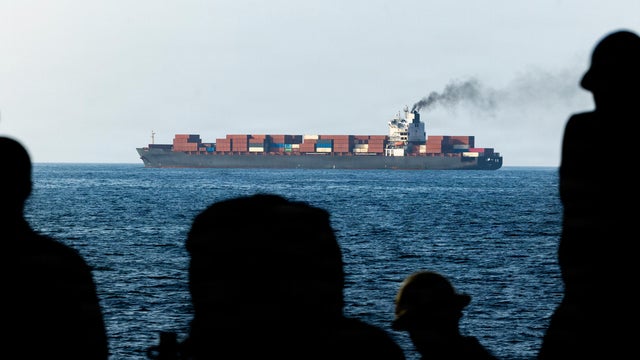
What to know about the Iran war today:
o Iran renewed its attacks on commercial vessels in the Strait of Hormuz Wednesday, as Tehran kept its grip on the vital shipping lane and called the U.S. military's blockade of Iranian ports a breach of the ongoing ceasefire.
o President Trump said Tuesday he was extending the ceasefire with Iran indefinitely, backing down from his latest threat to resume attacks if the regime didn't accept his terms for a wider peace deal. He insists the Islamic Republic is "collapsing financially" due to the U.S. blockade of its ports and will eventually capitulate and reopen the strait.
o Oil prices jumped again with a deal to end the Iran war looking far from imminent. As the U.S. sends thousands more forces to the region, an advisor to one senior Iranian official claimed that by extending the truce, Mr. Trump is "buying time for a surprise blow."
Trump tells New York Post peace talks with Iran "possible" as soon as Friday
President Trump said Wednesday that it's "possible" a second round of peace talks with Iran will begin as soon as Friday, according to the New York Post.
Asked about Pakistani officials telling the newspaper that talks might be possible within "36 to 72 hours," the post said Mr. Trump replied with a text message saying: "It's possible! President DJT."
Despite dire warnings from both sides and tit-for-tat interceptions of commercial ships in and around the Strait of Hormuz, the ceasefire between the U.S. and Iran has held since it was signed two weeks ago, and Mr. Trump said Tuesday that he was extending it indefinitely to give the Iranian regime time to formulate a unified response to his offer for a wider peace deal.
Pakistan, which has acted as an intermediary between Washington and Tehran, has urged both sides to sit down again for a new round of direct talks after brokering the first ceasefire agreement in Islamabad in early April.
Hezbollah, Israel accuse each other of ceasefire violations ahead of expected new talks in Washington
The Iranian-backed group Hezbollah in Lebanon and Israel's military accused each other of violating the fragile 10-day ceasefire between Lebanon and Israel on Wednesday, as ambassadors from both countries geared up for a new round of peace talks in Washington.
The Israel Defense Forces accused Hezbollah of launching an attack drone at its soldiers in southern Lebanon, calling it "a blatant violation" of the ceasefire agreed to by the Israeli and Lebanese leaders on April 16. The IDF said the aircraft was intercepted.
Hezbollah, which has long been designated as a terrorist group by the U.S. and Israel, claimed to have struck an Israeli artillery position in the Lebanese town of Al-Bayada with a drone "in response to the Israeli enemy's violation of the ceasefire and its continued aggression against villages in southern Lebanon."
Lebanon's national news agency reported, meanwhile, that Israeli strikes elsewhere had killed two people Wednesday, adding to the more than 2,000 the country's health authorities say have been killed by Israel's operations since the beginning of March.
Israeli officials say 23 people have been killed in the country by Hezbollah attacks since Israel's assault against the group ramped up in tandem with the war in Iran.
A first round of U.S.-brokered peace talks between Lebanon and Israel on April 14 led to the current 10-day ceasefire. A second round of talks between the countries, at the ambassador level, will take place at the State Department Thursday, a department official told CBS News on Tuesday.
Germany's Lufthansa cancels 20,000 more flights in Europe as Iran war sends jet fuel price soaring
Germany's flag carrier airline Lufthansa said Wednesday that it was canceling 20,000 short-haul flights within Europe to save money, citing the dramatic spike in the price of jet fuel caused by the U.S.-Israeli war with Iran, which has dramatically constrained the flow of petroleum products through the Strait of Hormuz.
"In total, 20,000 short-haul flights will be removed from the schedule through October, equivalent to approximately 40,000 metric tons of jet fuel, the price of which has doubled since the outbreak of the Iran conflict," the airline said in a statement.
"The planned consolidation of the European network is being carried out across Lufthansa Group's six hubs in Frankfurt, Munich, Zurich, Vienna, Brussels, and Rome," the airline said. "Passengers will therefore continue to have access to the global route network, particularly long-haul connections."
Several other major airlines — in both Europe and the U.S., which is far less reliant on fuel supplies from the Middle East — had already announced temporary flight cuts.
Air Canada, Delta, and other airlines announced cancellations earlier this month.
"The spike in oil prices is big news in general and the impact on jet fuel prices is pronounced," Stephen Rooney, lead economist at Tourism Economics, told CBS News last week. "Jet fuel is a huge cost for airlines, especially on longer-haul flights."
Tehran residents voice frustration over uncertainty as ceasefire extended, but war continues
Amid uncertainty over whether the ceasefire with the U.S. will last, Tehran residents voiced frustration and anxiety on Wednesday about what might come next.
"Last night my family all stayed awake, waiting for the clock to show 3:30 a.m. and see who really has the upper hand," said Reza Tehrani, a 34-year-old resident of Tehran, referring to the time many people expected the ceasefire to lapse.
Tehrani said President Trump had made a series of false claims, including that Iran would give up its enriched uranium.
"It's obvious that he will eventually take his warships back and nothing will happen," he predicted. "We will win, rest assured."
Another resident voiced frustration over the uncertainty.
"We should know where we stand. Is it going to be a ceasefire, peace or the war is going to continue?" Mashallah Mohammad Sadegh, 59, told The Associated Press. "The way things currently are, one doesn't know what to do."
Responsibility for war's economic fallout "lies with the aggressors," Iran's foreign minister says
Iran's top diplomat said Wednesday that responsibility for the global economic consequences of the U.S.-Israeli war with his country, which has sent energy prices soaring, "lies with the aggressors."
In a phone call with his Italian counterpart, Antonio Tajani, Iranian Foreign Minister Abbas Araghchi insisted that Iran, "as a coastal state of the Strait of Hormuz, has taken measures in accordance with international law to safeguard its national security against U.S. and Israeli threats and aggression," according to a readout of the call provided by the Iranian ministry.
"Responsibility for any consequences [of the war] on the global economy lies with the aggressors," he was quoted as telling Tajani.
International energy prices have spiked since the U.S. and Israel launched their attacks on Iran more than seven weeks ago, which has already driven up the price of goods and services across the board.
Economists have warned that U.S. motorists shouldn't expect fuel costs to return to where they were before the war, as neither Tehran nor Washington show any inclination to back down, and Iran's attacks and threats keep the Strait of Hormuz — a vital shipping lane for global energy supplies — gridlocked.
Oil prices rise, stocks mixed as hopes for quick resolution of Iran war dealt a blow
Oil prices edged higher Wednesday but the reaction in stock markets was less clear amid uncertainty surrounding the prospect of resumed Mideast peace talks following an extension of the U.S.-Iran ceasefire.
Asian equities had a mixed trading day as investors wait for clarity but broadly expect that both President Trump and authorities in Iran want to end a war that has sent oil and gas prices soaring.
"The ceasefire extension hasn't done much to calm nerves given that worries remain about the impact of the energy squeeze on the global economy," said Susannah Streeter, chief investment strategist at the Wealth Club."Shipments from the Middle East are in limbo and a resolution to the conflict remains elusive, and the price of Brent crude, the benchmark, reflects this."
International benchmark Brent Crude was again closing in on $100 a barrel, while main U.S. contract, West Texas Intermediate, traded back above $90.
Iranian gunboats attacked several commercial ships in the Strait of Hormuz Wednesday despite Mr. Trump announcing the previous evening that he was unilaterally extending a ceasefire to allow more time for peace talks.
"The US and Iran may be trying to shore up leverage and playing a game of who blinks first," said Christopher Wong, a strategist at Oversea-Chinese Banking Corp.
"Whatever the outcome, the suspense in the interim may see risk appetite being curtailed," he said.
European stock prices were down slightly, but Asian markets were mixed and S&P futures in the U.S. rose 0.5%, while Nasdaq futures gained 0.7% ahead of Wednesday trading.
Iran military-linked news agency calls subsea comms cables "vulnerable point for the region's digital economy"
Underwater communications cables beneath the Strait of Hormuz are "a vulnerable point for the region's economy," Iran's semi-official Tasnim news agency, which is closely linked with the country's powerful Islamic Revolutionary Guard Corps, said in a report Wednesday.
The article described the contested waterway as not only a chokepoint for oil and gas transit, but also for subsea cables that "form the backbone of data transfer, e-commerce, cloud services and online communications in Gulf countries."
"The concentration of numerous internet cables in a single narrow passage has made the Strait of Hormuz a vulnerable point for the region's digital economy," the Tasnim report said.
While the article did not include any explicit threat to the cables, the timing of its publication, with the U.S. and Iran locked in a standoff over control of the strait amid a tense ceasefire, was a clear hint that the cables could become targets for the IRGC.
In retaliation for the war launched by the U.S. and Israel on Feb. 28, Iranian forces have not only blocked commercial ship traffic through the strait but launched hundreds of missiles and drones at U.S. allies in the Persian Gulf.
Iran has also targeted several facilities belonging to major Western technology firms in the Gulf, and warned that more attacks on big corporations could follow.
Iranian foreign ministry says talks with U.S. will come only when there's a "necessary and rational basis"
Iranian Foreign Ministry spokesperson Esmail Baqaei said Wednesday that Tehran would only engage in peace talks with Washington when it deems there to be a "necessary and rational basis" for negotiations "to advance national interests and consolidate the gains achieved by the Iranian people in frustrating the enemies' objectives," according to Iran's official state news agency IRNA.
3 ships attacked in Strait of Hormuz after Trump announces indefinite extension of Iran ceasefire
Three commercial vessels came under attack in the Strait of Hormuz Wednesday, according to international news agencies, with the U.K. military and Iran's Revolutionary Guard confirming two of the strikes on cargo ships, potentially jeopardizing efforts to resume peace talks between the U.S. and Iran.
The U.K. military's Maritime Trade Operations Center (UKMTO) reported early Wednesday morning that an Iranian Revolutionary Guard Corps gun boat fired at a container ship 15 nautical miles northeast of Oman.
There was no radio warning before the boat "fired upon the vessel" causing "heavy damage to the bridge," according to UKMTO, which said all crew members were reported to be safe.
Three hours later UKMTO reported a second incident, this time 8 nautical miles west of Iran's coast at the eastern entrance to the Strait of Hormuz, in which a cargo ship said it was fired upon and was "now stopped in the water."
The crew were "safe and accounted for" and there was no mention of the suspected source of the fire, UKMTO said, but suspicion immediately fell on Iran.
In a statement, Iran's powerful Islamic Revolutionary Guard Corps said two vessels it accused of violating its blockade of the strait "had entered the area without proper authorization and allegedly tampered with their navigation systems, thereby endangering maritime safety."
The IRGC said the ships were intercepted "and escorted to the Iranian coast."
The Reuters and Associated Press news agencies and CBS News' British partner network BBC said a third ship was hit by gunfire in the strait Wednesday, but UKMTO did not immediately confirm that attack.
Iranian official says Trump's ceasefire extension "definitely means buying time for a surprise blow"
An advisor to Iran's powerful parliamentary speaker Mohammad Bagher Ghalibaf, who's also one of the Islamic Republic's lead negotiators, dismissed President Trump's indefinite ceasefire extension as a ploy to buy time for a military build up ahead of a "surprise blow" against his country.
"The extension of the ceasefire by Trump means nothing," Ghalibaf's aide Mahdi Mohammadi said in a post on X. "The continuation of the siege [U.S. naval blockade] is no different from the bombing and must be responded to militarily. In addition, the extension of the ceasefire on Trump's behalf definitely means buying time for a surprise blow."
President Trump said he was extending the truce to give the Iranian regime time to formulate a clear response to his terms for a wider peace deal, and he's repeatedly voiced optimism that Tehran will eventually capitulate to his demands under the economic pressure imposed by the naval blockade.
But with two U.S. aircraft carrier groups already deployed to the region, there are more than 50,000 American service members in the Middle East, compared to the roughly 30,000-40,000 typically based there.
U.S. Conducts Blockade Operations Near Strait Of Hormuz
A third carrier, the USS George H.W. Bush, along with three missile destroyers, an amphibious assault ship carrying around 2,500 U.S. Marines and a dock landing ship — used to move people and hardware from sea to shore - are currently on their way to the region.
Trump says Iran is "collapsing financially"
President Trump says Iran's economy is hurting badly and as a result, Tehran wants the Strait of Hormuz opened at once.
On his Truth Social platform late Tuesday night, Mr. Trump said, "Iran is collapsing financially! They want the Strait of Hormuz opened immediately- Starving for cash! Losing 500 Million Dollars a day. Military and Police complaining that they are not getting paid. SOS!!!"
Iran itself has been largely bottling up traffic through the vital waterway that a fifth of the world's oil and liquefied natural gas passes through in peacetime. The U.S. has been blockading all of Iran's ports.
Trump says if U.S. ends blockade "there can never be a Deal with Iran, unless we blow up the rest of their Country"
President Trump posted on Truth Social that Iran doesn't want the Strait of Hormuz closed and that "They only say they want it closed because I have it totally BLOCKADED (CLOSED!), so they merely want to 'save face.'"
"People approached me four days ago, saying, 'Sir, Iran wants to open up the Strait, immediately.' But if we do that, there can never be a Deal with Iran, unless we blow up the rest of their Country, their leaders included!" Mr. Trump wrote.
Treasury secretary threatens sanctions on those who help Iran export oil
Treasury Secretary Scott Bessent wrote on X that, due to the ongoing U.S. blockade of Iranian ports, "in a matter of days, Kharg Island storage will be full and the fragile Iranian oil wells will be shut in."
Kharg Island is a critical oil export terminal for Iran.
"Constraining Iran's maritime trade directly targets the regime's primary revenue lifelines," Bessent said. "The US Treasury will continue to apply maximum pressure through Economic Fury to systematically degrade Tehran's ability to generate, move, and repatriate funds."
"Any person or vessel facilitating these flows—through covert trade and finance—risks exposure to U.S. sanctions," he added.
On March 20, the Trump administration temporarily lifted sanctions on Iranian oil that is already at sea in an effort to ease worldwide gas prices. That waiver expired on Sunday.
Trump extends ceasefire with Iran indefinitely
President Trump said Tuesday afternoon on Truth Social that he was extending the ceasefire, which had been set to expire in the coming hours.
"Based on the fact that the Government of Iran is seriously fractured, not unexpectedly so and, upon the request of Field Marshal Asim Munir, and Prime Minister Shehbaz Sharif, of Pakistan, we have been asked to hold our Attack on the Country of Iran until such time as their leaders and representatives can come up with a unified proposal," Mr. Trump wrote. "I have therefore directed our Military to continue the Blockade and, in all other respects, remain ready and able, and will therefore extend the Ceasefire until such time as their proposal is submitted, and discussions are concluded, one way or the other."
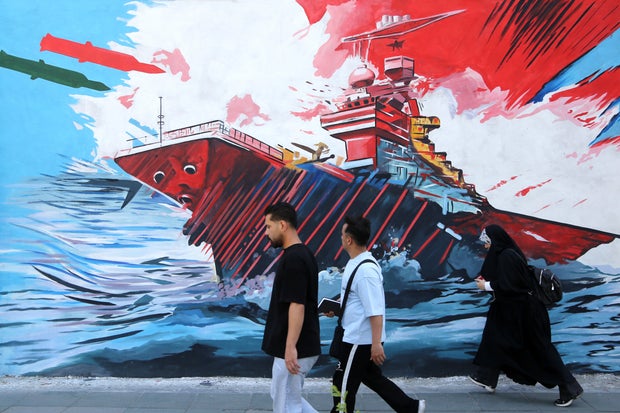
Tehran residents walk past a mural in the Iranian capital depicting a U.S. aircraft carrier being targeted by missiles, April 22, 2026. Fatemeh Bahrami/Anadolu/Getty
Source
Posted by Temmy
Yesterday at 3:18pm
| Smart Links To Latest Topics |
| Sections |
| Sections & Topics |
| Topics |
|
|
| Top |
|
For enquiries, notifications and ad placement send mail to sleeksmartservices@outlook.com Copyright 2019 - 2026 All Rights Reserved. Privacy Policy || Terms & Conditions |